Cooking can sometimes turn into a real puzzle when it comes to converting liquid measurements. Imagine preparing an American recipe using cups, while you only have milliliters on your utensils. Precision is key to achieving the perfect taste and texture.
Fortunately, a few simple tips can make this task less daunting. Knowing the basic equivalences, using online conversion tools, and having a multifunction kitchen scale are practical solutions. Even the most complex recipes become accessible, without measurement errors.
The Essential Basics for Understanding Liquid Measurement Conversions
Converting liquid measurements, a recurring challenge in cooking and laboratories, requires a clear understanding of the metric system. This includes units such as milliliters, centiliters, deciliters, and liters. Here are some basic equivalences:
- 1 milliliter (mL) equals 0.1 centiliter (cL)
- 1 centiliter (cL) equals 10 milliliters (mL)
- 1 deciliter (dL) equals 10 centiliters (cL)
- 1 liter (L) contains 100 centiliters (cL)
These conversions are essential for optimal precision in recipe preparation or scientific experiments. For example, converting 400 mL to cL is simple: just divide by 10, which gives you 40 cL.
Quick Conversion Table
| Milliliters (mL) | Centiliters (cL) | Deciliters (dL) | Liters (L) |
|---|---|---|---|
| 100 | 10 | 1 | 0.1 |
| 200 | 20 | 2 | 0.2 |
| 400 | 40 | 4 | 0.4 |
Consider this table as a quick reference for your conversions. In cooking, it will allow you to easily adapt recipes, while in the laboratory, it will ensure precise measurements for your experiments. Use these basics to master volume units and convert effectively between them.
Practical Tips for Effectively Converting Liquid Volumes
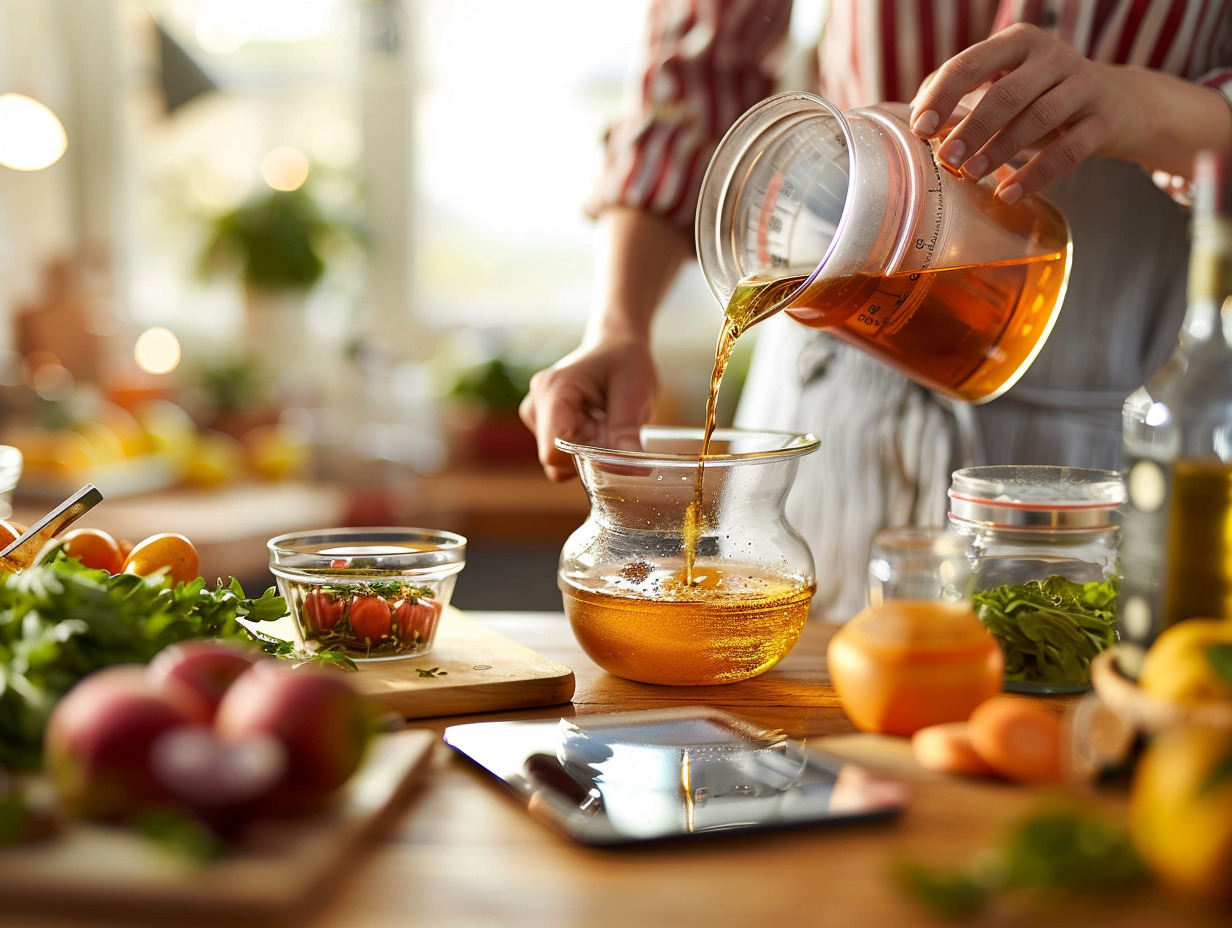
For smooth conversion of liquid volumes, several tools prove indispensable. In the kitchen, measuring cups and measuring spoons are valuable allies. These instruments allow for precise measurement of the milliliters and centiliters needed for each recipe. In the laboratory, graduated cylinders and syringes offer unmatched accuracy, ensuring the scientific rigor required.
Digital Tools and Mobile Applications
Technology also brings its share of practical solutions. Online conversion tools and specialized calculators make it easy to switch from one unit to another in just a few clicks. These platforms are invaluable for avoiding calculation errors and saving time. Mobile applications dedicated to liquid measurement conversion are convenient and accessible anywhere.
- Online conversion tools: handy for quick conversions.
- Specialized calculators: useful for precise and complex conversions.
- Mobile applications: portable and easy to use.
Precautions to Take
To ensure flawless conversion, follow the guidelines of the conversion tables and verify your measurements using appropriate tools. Precision is essential, especially in fields like cooking and laboratories where every milliliter counts. Always use calibrated and reliable instruments to avoid approximations.
Adopt these practical tips to master the art of liquid volume conversion.