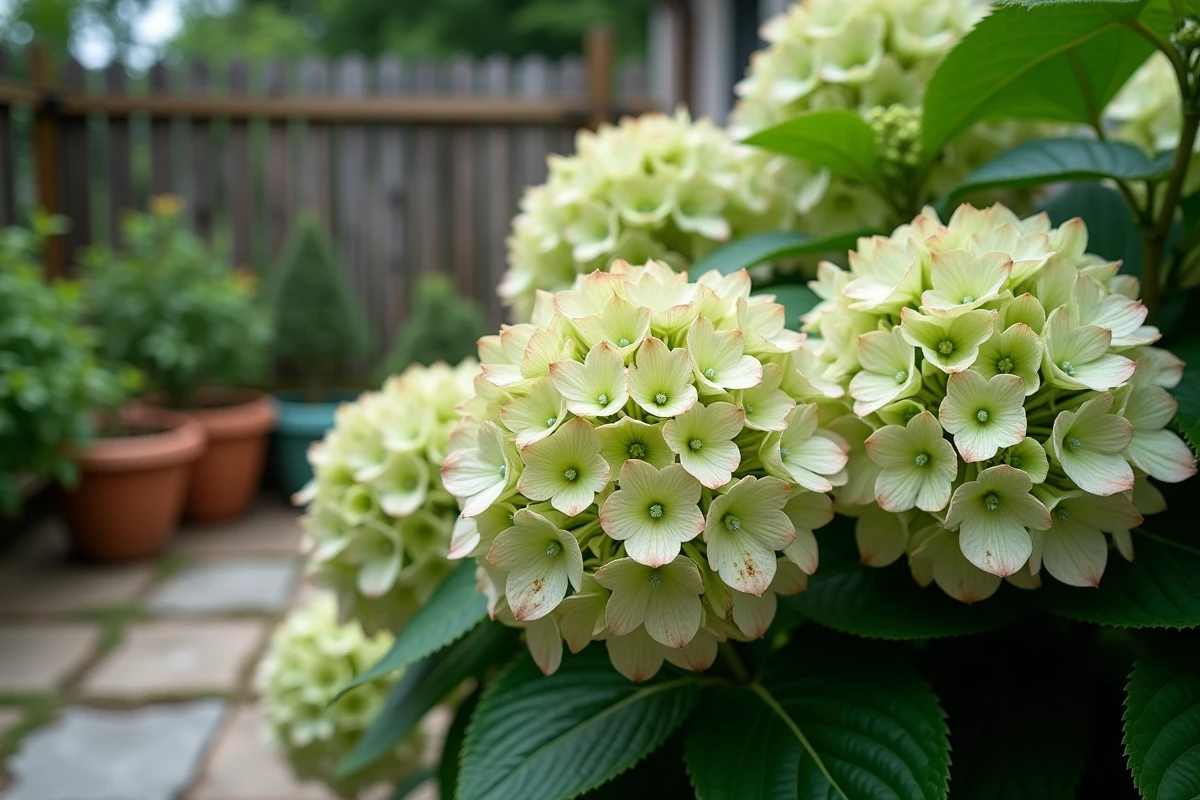
A bright pink hydrangea bought at a garden center that displays entirely green flowers by the second summer, we’ve all seen that. Before suspecting a disease or improper watering, one must look at the soil, the variety, and the timing in the flowering cycle. Understanding why a hydrangea turns green allows for action on the right levers, without wasting time or fertilizer.
Greening in pots: the trap of exhausted substrate
Potted hydrangeas turn green or dull more easily than those planted in the ground. The reason lies in a limited substrate volume: the roots quickly deplete the available phosphorus, iron, and potassium, three elements directly linked to the intensity of flower color.
This is often observed in a hydrangea repotted for two or three years without renewing the potting soil. The first inflorescences of the season emerge colored, then the following ones fade and take on a greenish hue. The soil simply no longer has what it takes to nourish the pigmentation.
To remedy this, repot in spring using a mix of heather soil and leaf mold, ensuring a pH between 5.5 and 6.5. This level of acidity promotes nutrient absorption by the roots. Soil that is too chalky or too neutral blocks iron and phosphorus, even if added. When wondering why a hydrangea turns green, the exhausted substrate in pots is the first lead to check.
Hydrangea varieties selected for turning green
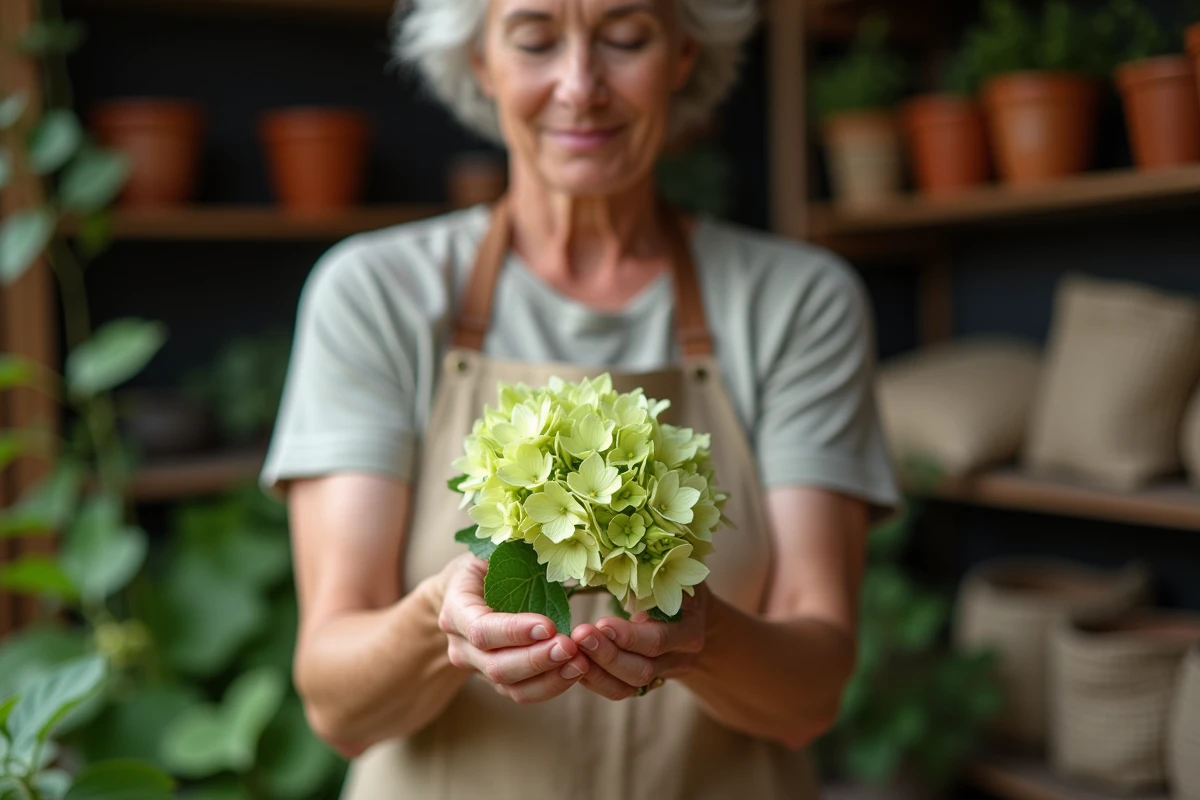
Not all green hydrangeas indicate a problem. Some recent cultivars are sold precisely for their evolution towards green hues at maturity. The varieties Magical Greenfire, Magical Green Delight, or Vibrante Verde go through white, pink, or red before finishing with a strong green at the end of summer.
In these cultivars, green is a stable varietal characteristic, not a sign of deficiency. If one has purchased a hydrangea labeled “Magical” or presented with photos of green flowers, the greening is perfectly normal and expected.
The reflex to have: check the label or the name of the variety before changing anything in the fertilization. Treating a genetically programmed hydrangea to turn green as if it were a sick hydrangea amounts to acidifying a soil that does not need it.
Soil acidity and hydrangea flower color
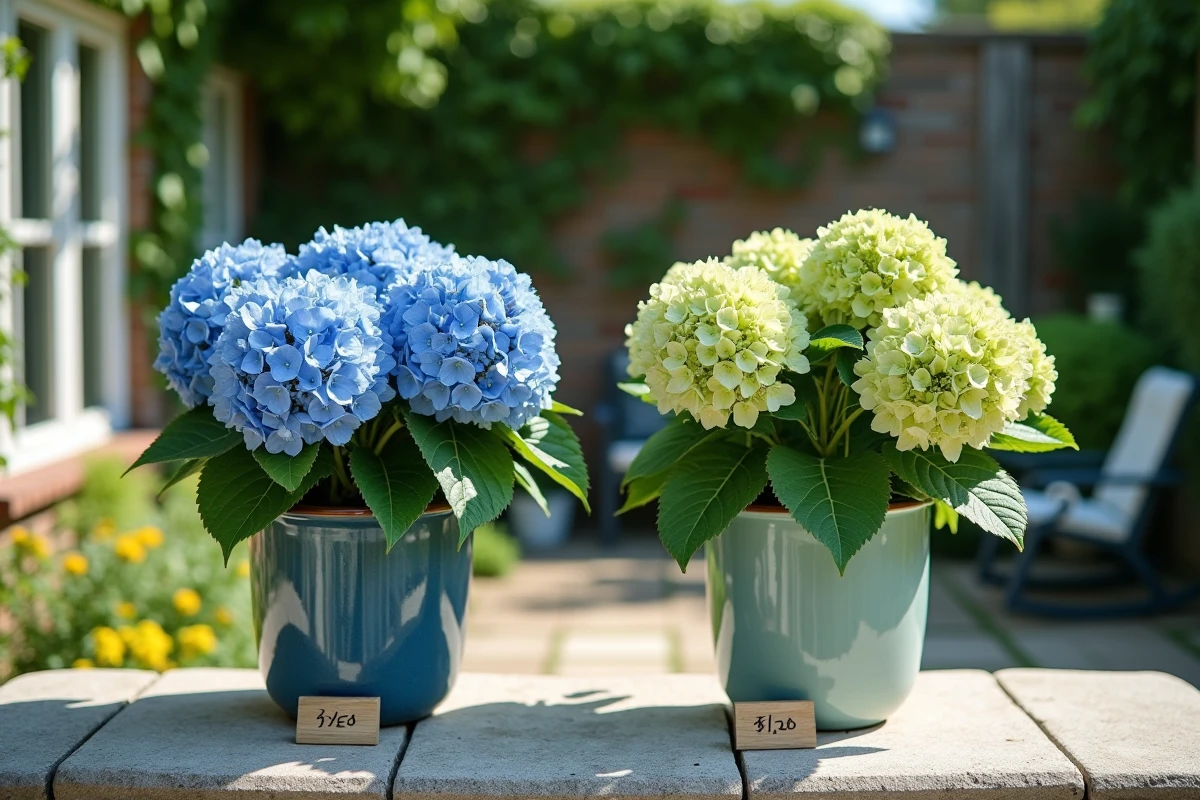
For classic varieties (Hydrangea macrophylla), the color of the flowers directly depends on the acidity of the soil and the availability of aluminum. Acidic soil produces blue flowers, while neutral to chalky soil tends towards pink. When the pH rises too high or the soil is depleted, the plant can no longer synthesize its pigments properly: the flowers appear washed out, dull, and then greenish.
Testing and correcting soil pH
A pH test with a kit sold at garden centers takes a few minutes. If the result exceeds 6.5, one can mulch with pine needles and incorporate heather soil around the base. The addition of aluminum sulfate helps restore true blues in overly neutral soil.
In heavy chalky soil, acidification remains difficult to maintain over time. Reports vary on this point: some gardeners achieve stable results with acidic mulch renewed each year, while others end up growing in containers to fully control the substrate.
- Acidic soil (pH below 5.5): intense blue flowers on varieties that allow it, but risk of aluminum toxicity if the dose is forced.
- Slightly acidic soil (pH 5.5 to 6.5): ideal range for good absorption of phosphorus, iron, and potassium, and thus well-colored flowering.
- Neutral to chalky soil (pH above 7): pink to dull flowers, frequent greening at the end of the season due to nutrient blockage.
Fertilizers and flowering: what exacerbates greening
An excess of nitrogen at the expense of phosphorus and potassium pushes the plant to produce foliage instead of concentrating its energy on flower pigmentation. One often sees very green and leafy hydrangeas whose inflorescences remain pale or greenish. The problem stems from a poorly balanced fertilizer or one applied too late in the season.
Choosing the right fertilizer for hydrangeas
One should favor a fertilizer rich in potash, applied in early spring when the buds swell. A second light application when the first flowers open supports coloration. After mid-July, all fertilization should stop to allow the plant to prepare for dormancy.
- Fertilizer type “hydrangeas” or “heather soil plants”: suitable formulation, rich in potassium and iron.
- Universal fertilizer with high nitrogen content: to be avoided, it nourishes the leaves and dilutes the color of the flowers.
- Homemade compost alone: interesting for soil structure, but insufficient to maintain colorful flowering if the soil is poor in trace elements.
Natural end of flowering: when green is simply a cycle
At the end of the season (August-September depending on the regions), most Hydrangea macrophylla see their flowers gradually turn green, then brown. This phenomenon is physiological: the plant stops producing pigments and the chlorophyll in the sepals takes over. This natural greening does not require any correction.
It can be distinguished from problematic greening by the timing. If the flowers emerge green as soon as they open in early summer, it is a nutritional or varietal issue. If they turn green after several weeks of colorful flowering, it is the normal cycle of the plant.
Pruning faded inflorescences at the end of flowering, just above the first pair of well-formed buds, allows the plant to concentrate its reserves for the following year. This gentle pruning, done before the first frosts, is the most useful gesture to achieve a vibrant flowering the following season.