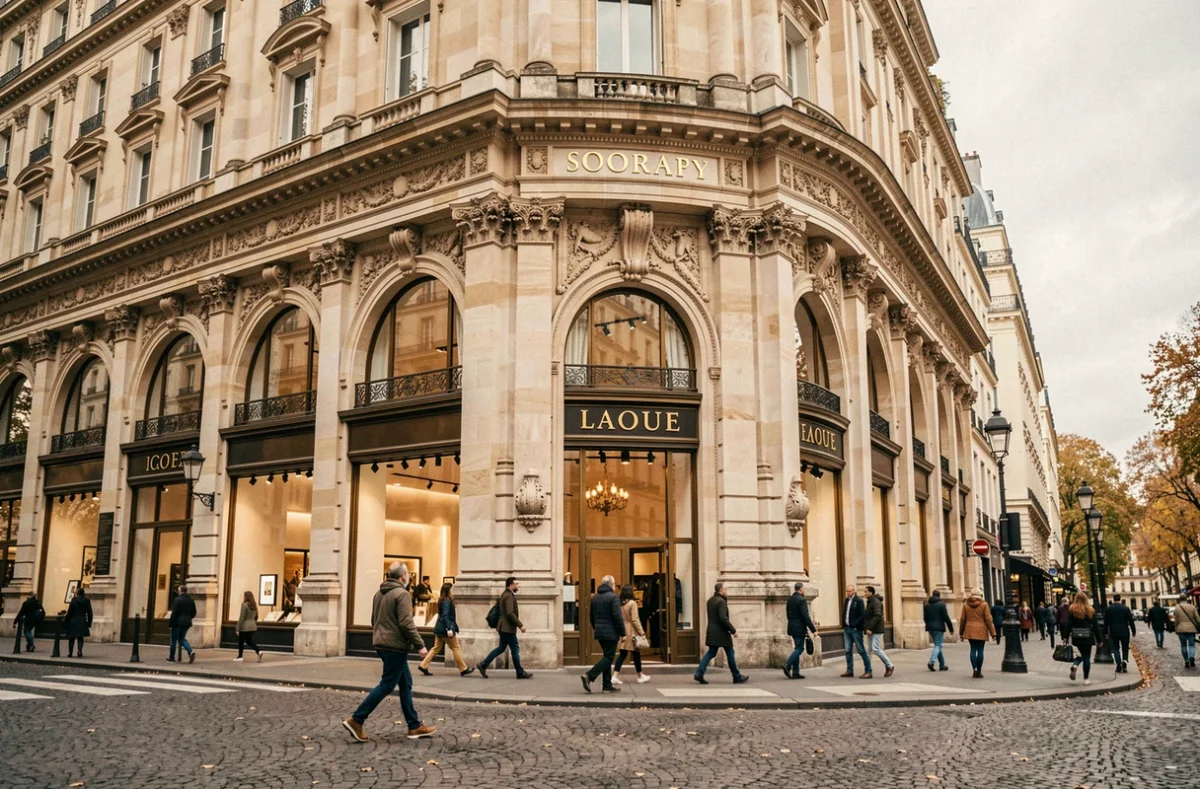
Identifying the number-one department store in France first requires choosing a measurement criterion. Sales floor area, annual footfall, flagship store revenue or the reach of the national network: each metric produces a different ranking. Galeries Lafayette Haussmann and Printemps Haussmann, just a few hundred metres apart on Paris’s Boulevard Haussmann, draw the most attention, but the available public data do not cover the same years or reporting scopes.
Floor area, footfall and revenue: available data
The table below brings together the published figures for the two flagship stores on Boulevard Haussmann. The sources do not all cover the same period, which limits direct comparison.
| Criterion | Galeries Lafayette Haussmann | Printemps Haussmann |
|---|---|---|
| Sales floor area | Approximately 70,000 m² | Approximately 44,000 m² (AFP/Boursorama source) |
| Annual footfall | 30 million visitors per year | Not recently disclosed |
| Store revenue | €1.5 billion in 2024 (Republik source) | No precise figure disclosed |
| Network strategy | Flagship stores + regional affiliation | Refocusing on local customers and digital sales |
On the two criteria for which published figures are available, the Galeries Lafayette Haussmann store is clearly ahead. Its sales floor is more than 25,000 m² larger than Printemps, and its 2024 revenue provides a benchmark that Printemps had not made public for a comparable period.
To determine the number-one department store in France, these differences in floor area and revenue point to an answer, while it is worth noting that the lack of comparable data from Printemps does not mean its performance is insignificant.
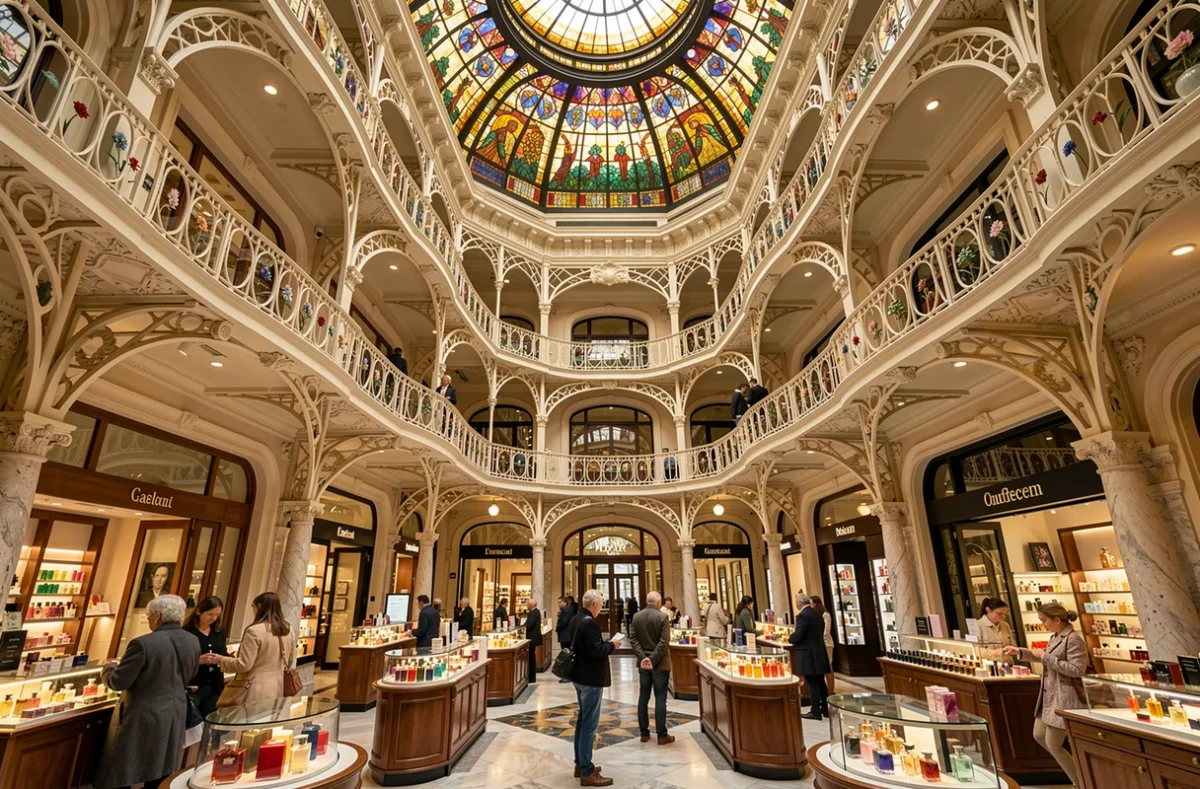
Galeries Lafayette Haussmann: why this store carries so much weight in its network
The €1.5 billion generated by the Haussmann store alone in 2024 deserves some context. This flagship accounts for a disproportionate share of the group’s overall revenue. According to Republik, the strategy rests on a two-pronged approach: major investment in flagship stores, led by Haussmann, and regional expansion through affiliation.
Affiliation allows Galeries Lafayette to maintain a nationwide presence without bearing the full operating costs of every store. Affiliated stores benefit from the brand and the group’s commercial strategy while remaining under the management of local entrepreneurs.
This structure explains a frequently overlooked point: the significance of a department store brand cannot be measured solely by its most visible Parisian building. Haussmann’s footfall and revenue figures obscure a regional network whose overall contribution receives less media attention.
Printemps Haussmann: a different turnaround strategy
Printemps has taken a different approach. According to Republik, the retailer has seen sales grow among local customers and through its online business, although it has not disclosed a recent overall revenue figure. This reflects a move to diversify beyond international tourism, which has long driven shopping on Boulevard Haussmann.
At 44,000 m², Printemps Haussmann is considerably smaller than its neighbour. This difference in scale directly affects the number of brands it can accommodate and the volume of visitors it can welcome.
- Printemps is focusing on building loyalty among customers in the Paris region, who are less dependent on seasonal tourist flows.
- Digital channels help it reach shoppers who do not visit the store—a strategy Galeries Lafayette also pursues, but from a higher starting point.
- Without a precise revenue figure, any direct comparison on this front remains unreliable.
Department stores in France: why rankings remain uncertain
Comparing two department store brands using public data raises several methodological issues. Reported floor areas sometimes include non-retail spaces. Footfall figures may combine unique visitors with repeat visits. And published revenue figures do not cover the same financial years.
A ranking that declares a “number one” without specifying the criterion oversimplifies a more nuanced reality. In terms of floor area and 2024 revenue for the Paris store, Galeries Lafayette Haussmann has a documented lead. As for local and digital sales momentum, Printemps reports growth, though its exact scale remains to be quantified.
What the data do not tell us
Profit margins, revenue per square metre and customer satisfaction are not included in the available data. These indicators might change the ranking—or confirm it. Without them, floor area and revenue remain the only measurable criteria.
The history of French department stores, which began in the 19th century with the Bon Marché model, has given rise to brands whose prestige goes beyond financial performance alone. Today, Galeries Lafayette Haussmann combines the largest documented sales floor, the highest reported footfall and the only precise revenue figure made public for an individual store.
Imperfect as they may be, these three figures make it the strongest contender for the title of France’s leading department store, unless a competitor publishes comparable results.