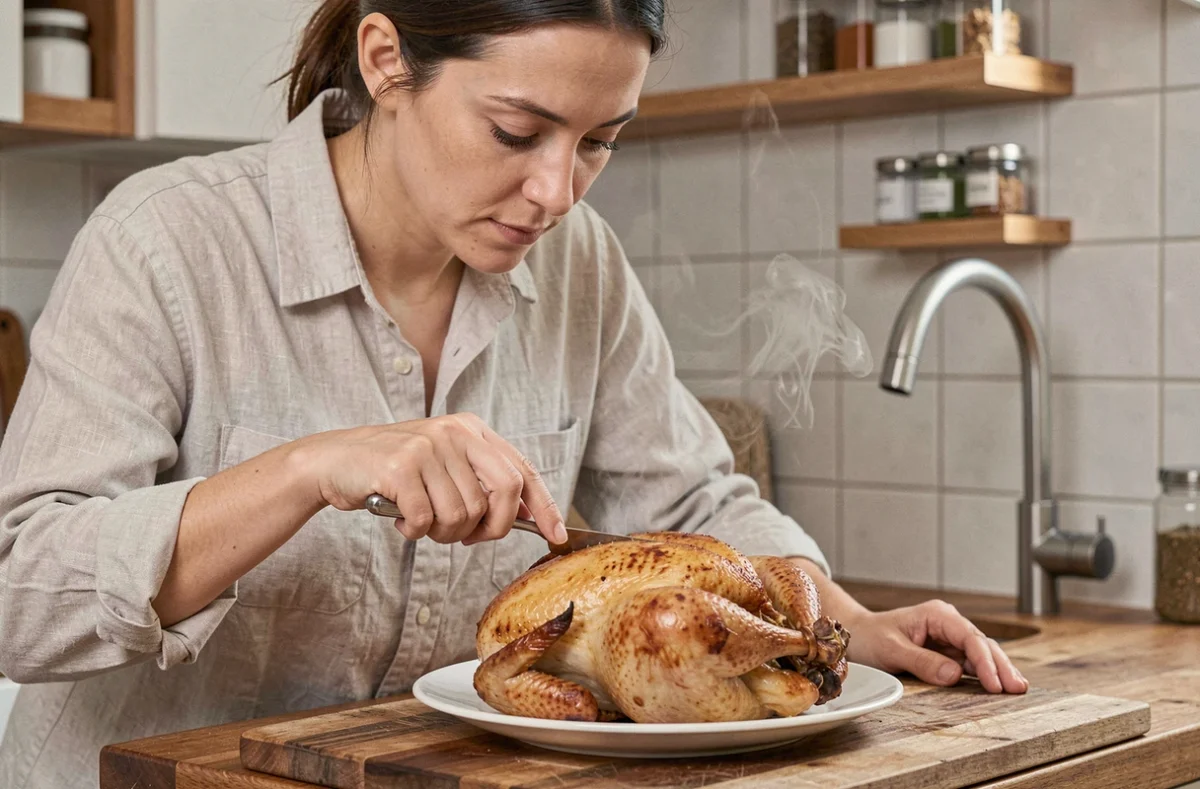
Let’s explore the anatomical aspects of cooked chicken: its meat turns white and its fibers tighten. Visual examination serves as another benchmark: a perfectly cooked chicken has golden, crispy skin with no traces of redness. Tactility offers another means of judgment: resistance under finger pressure indicates that cooking is complete, while excessive softness suggests otherwise. The ultimate validation, the tasting, remains the final confirmation. Juicy meat, developed flavor, and a pleasant texture on the palate confirm perfect cooking. These foolproof tips will help you judge without a thermometer whether your chicken is ideally cooked.
Preliminary Exploration: Anatomy of Cooked Chicken
The history of gastronomy is also one of culinary experimentation, discoveries, and scientific advancement. There was a time in the past when cooking was mainly a matter of intuition and tradition, but as our understanding of the world around us deepened, we began to adopt a more systematic and methodical approach.
This has been particularly true when it came to decoding the mysterious nature of cooked chicken. Over the centuries, both amateur and professional chefs have sought to master the subtle art of roasting a chicken to perfection. One of the techniques used to check if the chicken was well-cooked involved simply observing its color—a seemingly simple method that has nonetheless led to a great deal of misunderstanding.
The famous anchor check meat color is an integral part of the process. Indeed, it was not enough to just take a quick glance at the dish fresh out of the oven to judge whether or not our meal was ready to be served.
It was necessary to scrupulously analyze each piece to ensure that any trace of pink had disappeared, thus indicating that all potential risks related to bacteria had been eliminated.
Visual Method: Examining External Signs of Cooking
In the culinary world, the visual approach plays a fundamental role. It allows one to understand and evaluate the different stages of food cooking without the need for specific instruments. This technique primarily relies on observing changes in color, the formation of crusts, or the emission of bubbles during the process.
Careful observation is a skill that every good chef must possess. For example, in cooking meats, one can distinguish whether they are well-cooked simply by looking at their color: a brown exterior generally indicates that the meat is well-cooked, while a pink interior means it is medium-cooked. But beware! One should not rely solely on this because each piece has its own particularity and cooking time.
The same method applies to vegetables: when they lose their vibrant hue and become darker, it usually indicates that they are sufficiently cooked. Conversely, when boiling something like eggs or potatoes, look for bubbles: small at first, then growing over time indicate a gradual increase in temperature.
When grilling something under the broiler or on the barbecue, for example, watch for the formation of a characteristic golden crust that gives these dishes their unmistakable grilled flavors; it is also often a clear indicator that your dish is approaching the optimal cooking point.
However, this technique requires experience and knowledge to be mastered perfectly.
Tactility and Chicken: The Art of Touching to Judge Cooking
The art of palpation is often underestimated in the culinary world. Yet it is a valuable tool that allows both professional and amateur cooks to accurately determine the cooking state of poultry without relying solely on a timer or a thermal probe.
Touch, an underutilized sense in cooking: Our hands possess thousands of skin receptors capable of perceiving the slightest variations in temperature, texture, and density. They are therefore perfectly equipped to assess the progress of cooking if one takes the time to learn to listen to what they have to say.
Relying on practice to develop tactile intuition: The ideal is obviously to regularly handle raw and then cooked chicken to grasp all its nuances. One can start by palpating different parts of the bird before and after cooking (breasts, thighs…) to compare their respective consistencies.
The key: observe subtle changes when applying pressure. A well-cooked chicken will be firm but not too hard, indicating that its muscle fibers have had time to coagulate properly while retaining their natural juices. If, on the contrary, it remains soft even after several minutes in the oven, it probably hasn’t yet reached the recommended internal temperature (74°C).
One can also rely on anatomical markers.
Gourmet Epilogue: Tasting as the Ultimate Validation
A fine gourmet knows that tasting is the final judge of all cooking. For every prepared dish, it is the tasting experience that will determine the quality of the culinary execution and, above all, the crucial point of cooking. Beyond the various techniques used or the equipment involved in this critical step, no other criterion can compete with the verdict given by the taste buds.
Good cooking, for a discerning gastronome, is not merely a matter of temperature or time spent over the fire: it must primarily reveal the intrinsic flavor of the ingredients and exalt their harmony in combination. This is a subtle balance to achieve in order to resonate the senses through a unique experience.
The role of the gourmet is therefore not only that of a taster but also that of a true sensory analyst capable of assessing whether this complex alchemy has been respected. For example, a roast cooked well according to certain standards might be judged too dry by a more sophisticated palate seeking that precise point where the internal juices are released without altering the texture or diminishing the initial aromatic intensity.
The ultimate evaluation remains that of taste, as it faithfully reflects the successful (or unsuccessful) execution of the techniques employed during preparation and especially during that crucial phase known as cooking. Additionally, the visual aspect also plays its own role in the overall taste appreciation.